Two thousand years ago, a man from the Tamil country stood inside a pharaoh’s tomb and wrote his name on the wall. In 2026, someone finally read it.
CIKAI KOṞṞAṈ CAME HERE AND SAW
Two thousand years ago, a man from the Tamil country stood inside a pharaoh’s tomb and wrote his name on the wall. In 2026, someone finally read it.
A story about how far a name can travel — and how long it can wait to be read.
I. The name on the wall
Deep in the Valley of the Kings, in Egypt, there is a tomb cut into the rock for a pharaoh named Ramesses the Sixth. He was buried there more than three thousand years ago. On the walls of that tomb, and five others near it, there are names — hundreds of them — scratched by visitors who came long after the pharaohs were gone. Most are in Greek. Some are in Latin. And a few, high up on the stone, are in a script that no one who worked in that valley could read.
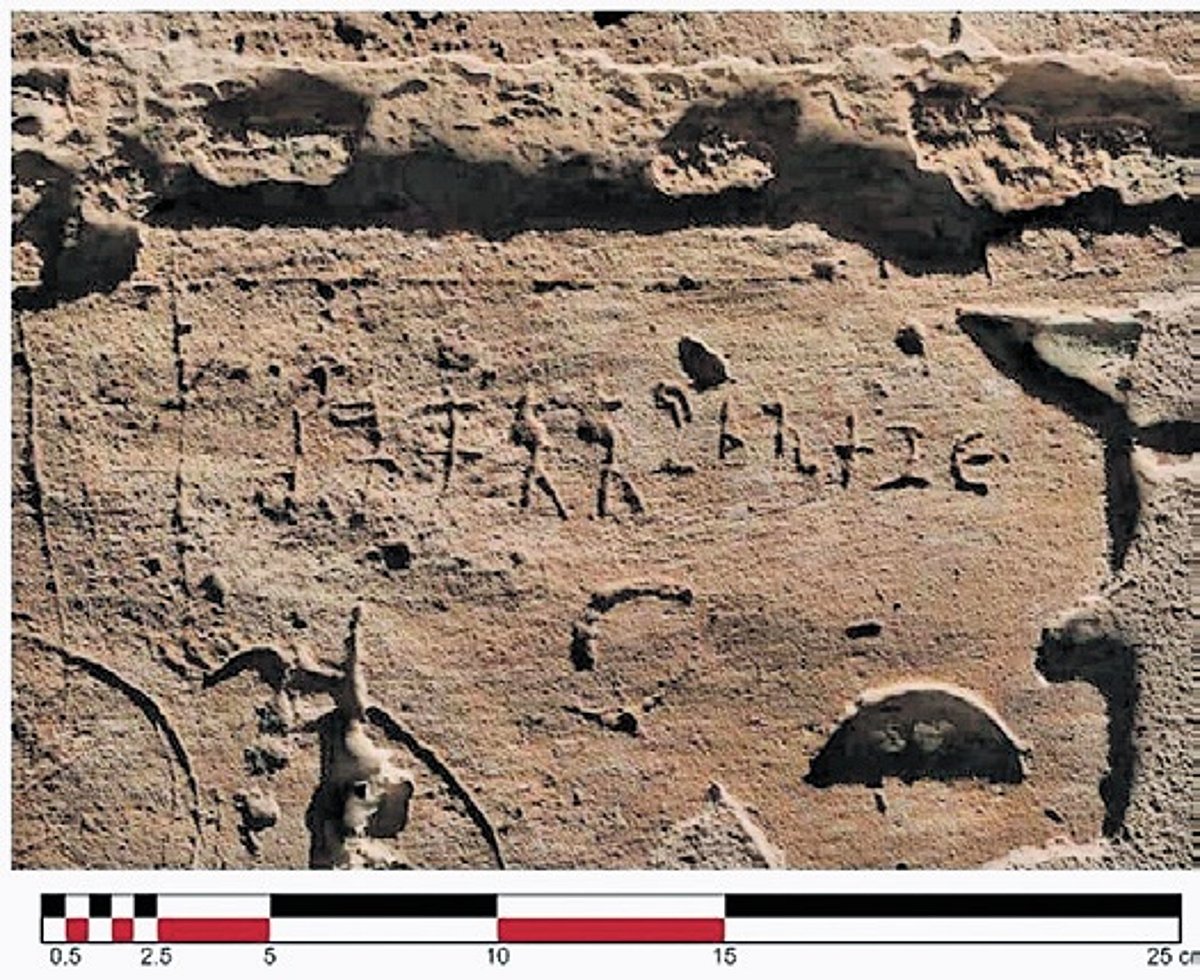
One name appears again and again — eight times, across five different tombs, one of them set five or six metres above a tomb entrance — so high that the scholars who found it say they still cannot work out how he reached to carve it. In the letters we use for Tamil today, it reads:
சிகை கொற்றன்
Cikai Koṟṟaṉ
“Cikai Koṟṟaṉ”
The two halves of the name come from two worlds, which suits a man found so far from home. Charlotte Schmid traces the first part, cikai, to the Sanskrit śikhā — a tuft or crown of hair; the second, koṟṟaṉ, is the distinctly Tamil part, from koṟṟam, ‘victory’ — the root of the warrior-goddess Koṟṟavai and of koṟṟavaṉ, ‘king.’
He carved it in Tamil-Brahmi — the earliest form in which the Tamil language was ever written, the angular script of his own century, older than the rounded Tamil letters we use now. And once, beneath his name, he wrote two more words. The scholars who finally deciphered them found something that made them smile, because it is the most human thing a traveller can write, in any language, in any century:
சிகை கொற்றன் வர கண்ட
Cikai Koṟṟaṉ vara kaṇṭa
“Cikai Koṟṟaṉ came here and saw.”
(The line above is written in modern Tamil letters; the scholars’ published reading of the carved script is romanised Cikai Koṟṟaṉ vara kaṇṭa. In a neighbouring tomb a second visitor left the same little formula — Kopāṉ varata kantan, ‘Kopāṉ came here and saw’ — another traveller’s hand, another name on the wall.)
Came here, and saw. Two thousand years before the phrase would mean anything to a tourist with a camera, a man from the far south of India stood in the tomb of an Egyptian king, looked around at the painted walls, and left a note to say he had been there.
II. The name that waited a hundred years
Here is the strange part. These Tamil names were not found last year by someone digging in the sand. They were on the walls the whole time. A French scholar named Jules Baillet surveyed these tombs more than a century ago — in 1888–89, and again in 1913–14 — and copied out some two thousand of the visitor-inscriptions. He gathered them into a great catalogue whose very title tells you what he could read and what he could not: Inscriptions Grecques et Latines des Tombeaux des Rois ou Syringes — the Greek and Latin Inscriptions of the Tombs of the Kings. The Indian marks were in that book too. Baillet had copied them, but he could not read them; unable to place the script, he set them aside under vague labels — ‘exotic,’ ‘Asianic’ — and there they stayed, printed and published and still unread, for a hundred years. The Tamil was hiding inside a book that named only two languages on its cover. It took someone who could read Tamil to open it and see a third. That someone arrived by chance: Professor Strauch first noticed the strange characters on a visit to the valley in early 2024.
It took until 2024 and 2025 for two scholars — Charlotte Schmid of the French School of Asian Studies in Paris, and Ingo Strauch of the University of Lausanne in Switzerland — to look at these marks with the right eyes and realise what they were. They presented their findings in February 2026, at a conference on Tamil inscriptions held in Chennai, in a paper with a title that traces the whole journey backwards: “From the Valley of the Kings to India.” As the Egyptologist Steve Harvey put it, the reason no one had recognised the inscriptions before was simply that no one with the right knowledge had looked at them closely enough to see what they were.
There is a lesson hiding in that hundred-year gap, and it is worth saying out loud: a thing can be sitting in full view, recorded and catalogued and printed in books, and still be invisible — until someone who can read it arrives. History is not only buried in the ground. Sometimes it is buried in plain sight, waiting for the right reader.
III. The world he sailed from
To understand how a Tamil name reached a pharaoh’s tomb, you have to start where the journey began — on the other side of the Indian Ocean, in the Tamil country, which its own poets called Tamilakam, two thousand years ago. And for that we are lucky, because the Tamils of that age wrote poetry, and some of it describes the very trade that carried men like Cikai Koṟṟaṉ out into the world.
The poems are called the Sangam poems, the oldest literature in the Tamil language. One of them, Akanāṉūṟu 149, describes a great port on the southwest coast called Muciri (the Romans knew it as Muziris), and the foreign ships that came there. The foreigners were called Yavanar — the Tamil word for the Greeks and Romans who sailed east. Here is what the poet saw:
சுள்ளியம் பேரியாற்று வெண் நுரை கலங்க
யவனர் தந்த வினைமாண் நன்கலம்
பொன்னொடு வந்து கறியொடு பெயரும்
வளங்கெழு முசிறி ஆர்ப்பெழ வளைஇ
cuḷḷiyam pēriyāṟṟu veṇ nurai kalaṅka / yavanar tanta viṉaimāṇ naṉkalam / poṉṉoṭu vantu kaṟiyoṭu peyarum / vaḷaṅkeḻu muciṟi ārppeḻa vaḷaiī
“Muciri, rich in prosperity — where the fine, well-wrought ships of the Yavanar churn the white foam of the Cheras’ great river, arriving with gold and leaving with pepper, and the harbour roars around them.”
— Akanāṉūṟu 149:8–11, poet Eṟukkāṭṭūr Tāyaṅkaṇṇaṉār (1st–3rd century CE)
Read that again, because it is astonishing: a Tamil poet, writing at the very same time Cikai Koṟṟaṉ was carving his name in Egypt, described the ships that made such a journey possible — arriving with gold, leaving with pepper. The poem and the graffito are two ends of the same rope, written in the same century, in the same language. One Tamil stayed home and watched the ships come in. Another sailed away on one.
And the traffic ran both ways. The Romans wanted Tamil pepper so badly that the Roman writer Pliny grumbled that India drained his empire of fifty million sesterces a year. Roman ships kept coming. Roman gold coins are still dug up across Tamil Nadu today. Some of the Yavanar did not just visit — they stayed: there was a foreign quarter, the Yavanar Irukkai, in the Tamil port-city of Kaveripattinam, where Romans lived and traded. Other Sangam poems describe Yavanar working as bodyguards to Tamil kings — tall, hard-eyed men in strange stiff clothes, standing watch over the royal tent — and selling beautiful lamps shaped like maidens holding oil in their cupped hands.
IV. The road to the tomb
So how did a man from Muciri end up in a valley of dead kings, a thousand miles up the river Nile? The road is known, even if we cannot prove which ship he took.
It began with the wind. Long before, a sailor had discovered that the winds over the Indian Ocean reverse with the seasons — blowing east toward India through the summer, and back west toward Arabia and Egypt through the winter. Once you knew the secret of the monsoon, the ocean was no longer a wall. It was a road you could ride in both directions.
A traveller leaving the Tamil coast would sail west across the open ocean on the winter wind, past Arabia, to the Red Sea. There, on the Egyptian shore, stood the port of Berenike — a hot, crowded, salt-white town full of Greeks, Egyptians, Arabs, and Indians, all unloading ships. We know Tamils passed through Berenike, because they left their names there too, scratched on pieces of pottery: names like Cātaṉ, and Koṟṟaṉ — the very same name that appears in the tombs. And the threading of names runs wider still: a Kīraṉ is carved in one of the tombs, and a Kīraṉ also turns up in the Tamil inscriptions at Pukalūr, back home, and on a potsherd dug up in Oman, out along the same sea-road — one more name scattered like a handful of seed across the whole length of the trade. From the coast, the traveller would cross the Eastern Desert by camel, about twelve days’ walk, to the river Nile. And then he would go up the greatest river in the world, to the ancient city of Thebes — and to the Valley of the Kings.
By the time Cikai Koṟṟaṉ arrived, those royal tombs were already more than a thousand years old. He did not come as a conqueror, or a builder, or a contemporary of the pharaohs. He came as something gentler and more familiar: a visitor. As Professor Strauch put it, the Valley of the Kings in his day “was a tourist destination, like today.” People came from all over the known world to see the wonders, and, being human, to leave their names. The Tamil travellers did exactly what the Greek and Roman ones did. They signed the wall.
V. What the walls do — and do not — say
It would be easy, and tempting, to make this story bigger than it is. Some of the headlines already have. So let us be careful, because the true story is remarkable enough without stretching it, and stretching it only gives doubters a reason to wave the whole thing away.
The inscriptions are not from the age of the pharaohs. The tombs are around three thousand years old; the Tamil writing on them is about two thousand years old — carved a thousand years after the kings were entombed, in the period when Egypt was a province of Rome. The proof of the date is on the wall itself: one of the longer inscriptions, in Sanskrit, names Indranandin, a messenger of the Kshaharata kings — a dynasty that ruled part of western India in the first centuries of our era. That anchors the whole set firmly in the early centuries of our era. Anyone who tells you Tamils were in Egypt in 1600 BCE has confused the age of the tomb with the age of the graffiti.
And the travellers were not only Tamil. Of the roughly thirty Indian inscriptions, about twenty are in Tamil-Brahmi — the clear majority, and the reason the discovery was announced at a Tamil conference — while the rest are in Sanskrit, Prakrit, and Gandhari. This was a pan-Indian presence: people from across the subcontinent, who could often read Greek as well as their own scripts, moving through the same Roman world. The honest pride here is not “Tamils alone reached Egypt.” It is something larger: that the Tamil country was one full participant in the first great globalisation the world ever knew — a crossroads that ships sailed toward, and sailed out from.
VI. The lamp that is still burning
There is a small object that ties this whole story together, and you may have one in your home.
In those same Sangam poems, the Tamils admired the lamps the Yavanar brought — among them a lamp shaped like a swan, set high on a post. Look at the tall metal lamp lit today at Tamil weddings, at temple doorways, at the opening of a new shop — the kuṭṭu viḷakku, and the swan-lamp beside it. Some scholars believe the shape came, two thousand years ago, along the same sea-road that carried the pepper out and the gold in — a foreign design that became so completely Tamil that no one now remembers it was ever a stranger. Every time that lamp is lit, a two-thousand-year-old exchange flickers on for a moment, unnoticed.
That is what these tomb inscriptions really are: another ember from that same fire. Not a boast about empires, but a record of ordinary, astonishing human movement. Most of the travellers who came this way, Charlotte Schmid thinks, were merchants — but Cikai Koṟṟaṉ, she suspects, was not. His is not a trader’s name. It is a warrior’s — koṟṟam is victory — and she reads him as a soldier, perhaps one of the armed men who travelled with the merchant ships as guards. If she is right, then the Sangam poems have already shown us his kind: the hard-eyed Yavanar who stood watch over Tamil kings were the mirror image of a Tamil fighting man standing now in a pharaoh’s tomb a world away. A young man far from the Tamil coast, standing in the cool dark of a dead king’s tomb, reading the Greek names around him, and adding his own in the script his mother tongue was first written in.
He wrote came here and saw. He could not have imagined that the seeing would outlast him by two thousand years — that his two small words would wait on the stone through the fall of Rome and the whole of the age that followed, unread, until a day when someone who knew his language would finally stand where he stood, look up at the wall, and read his name back into the world.
Cikai Koṟṟaṉ came here, and saw. And now, at last, he is seen.
A NOTE ON SOURCES
The Valley of the Kings inscriptions were identified by Charlotte Schmid (École française d’Extrême-Orient) and Ingo Strauch (University of Lausanne) in a 2024–25 study, presented as “From the Valley of the Kings to India: Indian Inscriptions in Egypt” at the International Conference on Tamil Epigraphy, Chennai, 11–14 February 2026, and published in the conference Proceedings Volume 1 (Government of Tamil Nadu, 2026): close to 30 inscriptions across six tombs in the Theban necropolis, including that of Ramesses VI; roughly 20 in Tamil-Brahmi, the remainder in Sanskrit, Prakrit and Gandhari-Kharoshthi; dated to the 1st–3rd centuries CE, with the Kshaharata-envoy Sanskrit inscription serving as the chronological anchor. The name Cikai Koṟṟaṉ appears eight times across five tombs; Schmid connects the element koṟṟaṉ to koṟṟam (‘victory’), the goddess Koṟṟavai, and koṟṟavaṉ (‘king’). Jules Baillet’s surveys (1888–89 and 1913–14) were published as Inscriptions Grecques et Latines des Tombeaux des Rois ou Syringes; he catalogued the Indian marks without identifying the script, labelling them ‘exotic’ or ‘Asianic.’ Charlotte Schmid’s reading of Cikai Koṟṟaṉ as more likely a soldier or travelling guard than a merchant, the tomb numbers (1, 2, 6, 8, 9, 14), and the additional names Kīraṉ (attested at Pukalūr and on an Oman potsherd) and Kopāṉ are reported in BBC Tamil (Muralidharan Kasiviswanathan, 13 February 2026), which draws on the scholars directly. Tamil-Brahmi names at the Red Sea ports (Koṟṟaṉ/Koṟṟapūmāṉ, Cātaṉ, Kaṇaṉ) are attested at Berenike and Myos Hormos and discussed in the Journal of Global History (2023). The Muciri verse is Akanāṉūṟu 149:8–11; Puṟanāṉūṟu 343 (Paranar) and the Yavanar references in Nedunalvāṭai (101–103), Perumpāṇāṟṟuppaṭai (316–317) and Mullaippāṭṭu describe the trade, the resident Yavanar and the lamps. The monsoon route and Roman trade follow the Periplus of the Erythraean Sea and Pliny’s Natural History. The Akanāṉūṟu 149 quotation (lines 8–11) has been checked against a printed critical edition, which sets veṇ nurai as two words; the graffito romanisation follows published reporting of the Schmid–Strauch paper pending the printed Proceedings volume. The swan-lamp origin is presented as a scholarly suggestion, not a settled fact.
— END —
Mystic Quill | Research & Writing by Selva Ganesh K | 2026
mysticquill.blog


Comments
Post a Comment